Monsoon Baby Skin Care: Little Q 3T Gentle Bath Guide
Explore monsoon baby skin care with Little Q 3T’s hair-and-body wash. Learn gentle bathing, careful drying and everyday tips for your baby in humid weather.Little Q
Monsoon Baby Skin Care: Little Q 3T for Humid-Weather Comfort
Rain brings welcome relief from summer heat, but it can also make everyday baby care feel different. Clothes take longer to dry, little neck folds become sweaty, and a freshly bathed baby may feel sticky again sooner than expected.
Monsoon baby skin care is not about washing more aggressively. It is about balancing gentle cleansing with careful drying, comfortable clothing and attention to areas where moisture collects.
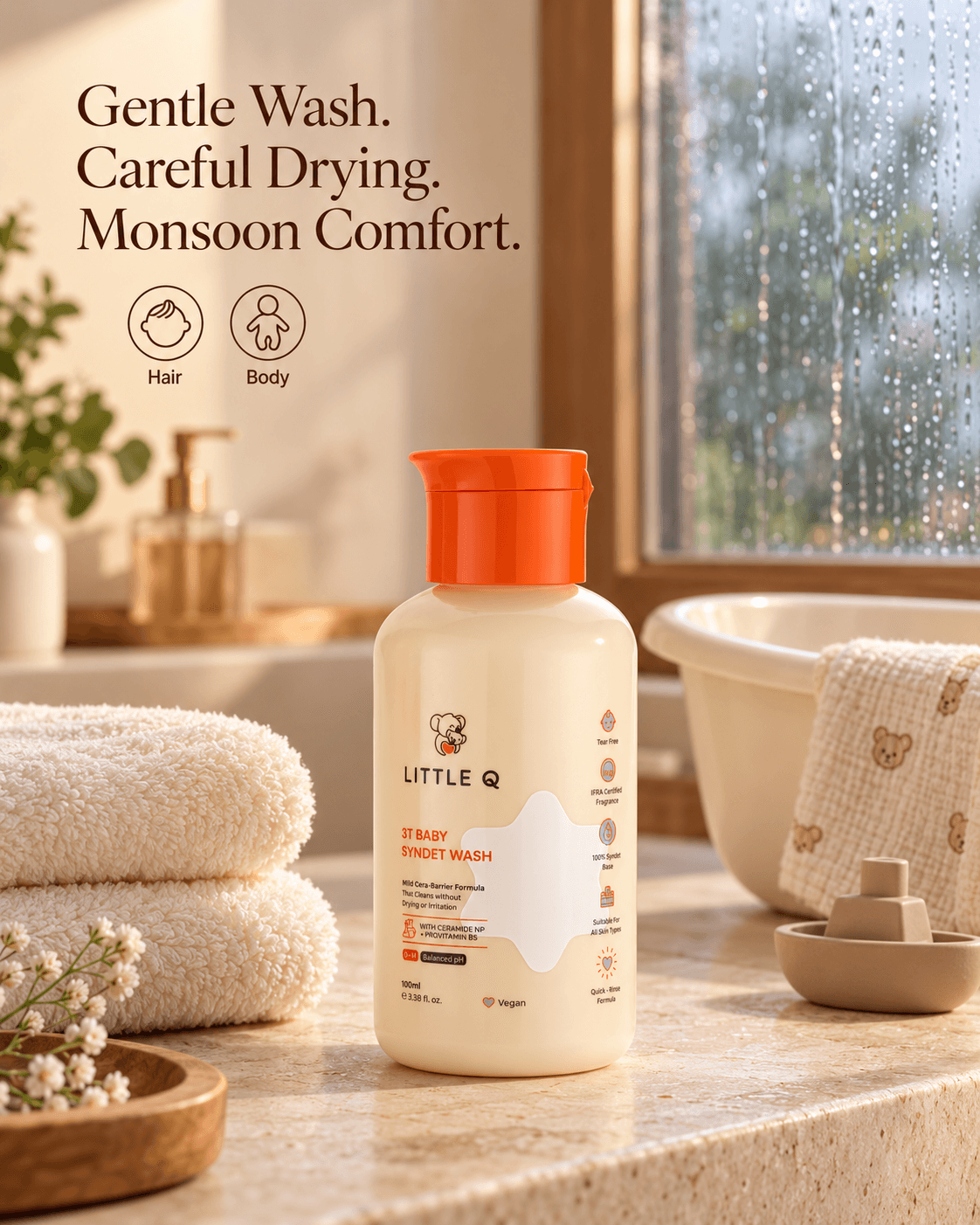
Little Q 3T baby wash offers a convenient cleansing option. Its manufacturer describes it as a head-to-toe syndet wash for delicate newborn and sensitive skin, intended for both hair and body. When suitable for your baby, it can remove the need for separate everyday shampoo and body wash.
Think of it as one part of a humidity-aware routine—not a “humidity-proof” coating or a treatment for seasonal rashes.
Why Monsoon Baby Skin Care Needs a Different Rhythm
A rainy day does not automatically cause skin problems. The more useful question is what changes around your baby: warmth, sweating, damp clothing or moisture remaining against the skin.
Infant skin is thinner, more fragile and more sensitive than adult skin. Appropriate cleansing and moisturising help maintain its protective barrier.
During sticky weather, parents may be tempted to respond with frequent baths, stronger products or powder. Those choices are not necessarily helpful.
More moisture does not mean better hydration
Sweat or damp fabric sitting against the skin is different from comfortable, well-moisturised skin.
The nappy area illustrates the difference. Constant moisture, rubbing and occlusion can irritate and damage the skin, which is why frequent changes and gentle cleaning matter.
Instead of trying to make every area feel “squeaky clean,” aim for clean skin, dry folds and clothing appropriate to the temperature.
Watch the baby, not only the weather forecast
A comfortable baby in a cool room may need a different routine from a baby who has become sweaty during an outing.
Look for damp clothing, trapped moisture and signs of discomfort. Avoid assuming that every rainy day requires an extra full bath.
The Royal Children’s Hospital recommends bathing according to individual need, using warm water and a mild, soap-free cleanser as required.
What “Humidity-Proof Protection” Can Realistically Mean
No rinse-off wash makes a baby’s skin immune to humidity, sweating or infection.
The reviewed Little Q 3T product information describes an all-season formula and barrier-support positioning. It does not establish a clinically tested “humidity-proof” effect or show that the wash prevents monsoon-related rashes.
A more useful interpretation of protection is a routine that reduces avoidable irritation.
That means:
Cleansing gently when needed.
Rinsing away product.
Drying folds carefully.
Changing damp clothing.
Avoiding overheating.
Using appropriate moisturiser for dry skin.
Seeking help for persistent or concerning symptoms.
Little Q 3T can contribute to the cleansing step. The rest depends on everyday care.
This distinction keeps the product’s role clear while helping parents focus on actions that matter beyond bath time.
Where Little Q 3T Fits Into the Routine
Little Q 3T is a baby syndet wash. “Syndet” means synthetic detergent: a non-soap cleansing system.
The manufacturer describes the wash as soap-free, pH-balanced, sulfate-free and paraben-free. Its highlighted cleansing ingredients include SCI-85, Decyl Glucoside and Sodium Cocoyl Glycinate.
Gentle cleansing rather than seasonal scrubbing
A gentle baby cleanser should help remove ordinary surface residue without encouraging harsh rubbing.
The Royal Children’s Hospital recommends a mild, soap-free cleanser when needed and advises avoiding bubble bath because it may remove natural oils.
Little Q 3T’s soap-free positioning is relevant to that general approach. It is not a guarantee that the formula will suit every baby.
Conditioning ingredients alongside cleansing
The official product page highlights Ceramide NP, Niacinamide, D-Panthenol, Hyaluronic Acid, Oat, Calendula, Aloe Vera and Licorice. Glycerin also appears in its product information.
These ingredients explain the brand’s conditioning and hydration-focused positioning.
However, the product is rinsed away. Their presence should not be used to claim that the wash replaces moisturiser, treats eczema or provides a measured number of hours of protection.
A realistic role in baby skin barrier care
The strongest expectation is straightforward: a cleanser formulated with skin comfort in mind, used within a gentle routine.
If skin remains dry after bathing, additional leave-on care may be necessary. The Royal Children’s Hospital recommends a thick, non-fragranced moisturiser at the first sign of dryness.
One Wash for Hair and Body: A Practical Monsoon Advantage
Rainy season baby care can already involve extra laundry, spare clothes and towels that need replacing more often.
A baby hair and body wash can make the cleansing part less complicated.
Little Q 3T is explicitly marketed for true top-to-toe use. When it suits your baby, a separate everyday shampoo and body wash may be unnecessary.
One product, two routine tasks
You do not need to alternate between two bottles simply because one area is the scalp and another is the body.
Follow the current label directions for both areas. This keeps the routine consistent without asking parents to improvise with a product intended only for adult hair or body care.
Easier instructions for other caregivers
A grandparent or another caregiver can follow one set of cleansing instructions.
That simplicity can be helpful when the rest of the routine involves checking water temperature, supporting the baby and preparing dry clothes.
It is a convenience benefit—not proof of faster bathing or superior medical outcomes.
No need to buy duplicate products by habit
Before adding another shampoo to the shelf, ask whether there is a specific need.
The Royal Children’s Hospital notes that most babies’ hair does not require shampooing; when cleansing is needed, a gentle, pH-neutral product is appropriate and a soap-free wash is usually suitable.
A scalp condition may require different advice. Ordinary cleansing does not automatically require a second bottle.
The Wash–Dry–Dress Approach
The most useful monsoon routine follows the baby beyond the water.
Step 1: Prepare a completely dry landing
Before starting, place a dry towel, clean clothes and a fresh nappy within reach.
Choose a safe bathing area and maintain continuous adult supervision. Preparation should make the routine calmer, not encourage rushing.
If the usual towel is still damp, choose another fully dry one rather than wrapping the baby in it.
Step 2: Keep cleansing brief and gentle
Use comfortably warm water. The Royal Children’s Hospital suggests baths lasting about five to ten minutes, every few days or as needed.
Use Little Q 3T according to its current directions. Do not keep adding cleanser merely to produce more bubbles.
The manufacturer describes its foam as soft and controlled.
Step 3: Rinse before reaching for the towel
Remove cleanser from the scalp and body rather than letting it collect in creases.
Take particular care around the neck, underarms and groin. Avoid vigorous scrubbing and keep wash away from the eyes.
A tear-free claim does not make deliberate eye exposure appropriate.
Step 4: Pat dry, then check folds
Pat rather than rub.
The Royal Children’s Hospital specifically advises paying attention to skin folds after bathing.
Gently check behind the ears, beneath the chin, under the arms and around the groin. The aim is to remove remaining water without repeatedly rubbing delicate skin.
Step 5: Dress for comfort
Choose light, loose, soft cotton clothing and avoid overdressing. This aligns with the hospital’s infant skincare guidance.
A rainy day can still be warm. Judge clothing by the baby’s comfort and indoor conditions rather than automatically adding heavy layers.
Caring for Folds, Nappies and the Scalp
Baby skin care in humid weather benefits from targeted attention rather than repeated full-body washing.
Neck folds: clean what collects
Milk, saliva and sweat can collect beneath the chin.
Check the area during ordinary care. Gently clean visible residue and dry the fold without forcing or scrubbing.
If the skin becomes persistently red, sore or weepy, do not keep applying more wash. Seek advice.
Nappy area: respond promptly to wetness
Change wet or dirty nappies as soon as possible.
The NHS recommends cleaning the entire nappy area gently, including folds, and allowing some nappy-free time when practical.
For irritated nappy skin, water or fragrance-free, alcohol-free wipes are recommended; soap and other potentially irritating products should be avoided.
A head-to-toe wash should not be treated as the answer to every nappy-area problem.
Scalp: cleanse without picking
Use the product as directed when scalp cleansing is needed.
Do not scratch or pick at flakes. The Royal Children’s Hospital advises seeking help if scalp skin becomes itchy, inflamed or weepy.
Damp weather does not establish the cause of scalp changes. Cradle cap, irritation and other conditions need to be distinguished rather than labelled “monsoon fungus” at home.
Heat Rash and Other Irritation: Know the Difference
Not every small bump is caused by poor hygiene.
The NHS explains that heat rash develops when sweat glands become blocked and sweat is trapped. Babies are more prone to it because their temperature regulation is less mature.
Baby heat rash care starts with cooling
The central advice is to keep the skin cool and avoid further sweating.
Loose cotton clothing and lightweight bedding can help. The NHS also advises avoiding perfumed shower gels or creams on heat rash.
Do not assume extra cleanser will clear blocked sweat glands. Little Q 3T is a cosmetic wash, not a heat-rash treatment.
Skip powder as a humidity solution
Powder is not a substitute for drying, comfortable clothing or prompt nappy changes.
The Royal Children’s Hospital does not recommend baby powder or talcum powder for infant care.
Avoid layering powder over damp folds or irritated skin.
Persistent redness needs assessment
A rash may reflect irritation, eczema, infection or another cause.
Seek medical advice if it does not improve, appears painful, spreads or causes concern. Do not start antifungal, steroid or antiseptic treatment simply because the weather is humid. The NHS advises consulting a doctor when a baby has a concerning rash.
A Monsoon-Ready Baby-Care Corner
A few organisational changes can make daily care more manageable.
Keep together:
Little Q 3T, if suitable for your baby.
Clean, fully dry towels.
Spare lightweight clothes.
Fresh nappies.
A soft cloth.
Any moisturiser or barrier product your baby needs.
Store the wash according to its label and close it after use. Do not add water, oils or homemade ingredients to the bottle.
Keep wet items separate from clean supplies. Replace damp clothes rather than leaving them against the skin.
This is where the product’s convenience becomes useful: one hair-and-body cleanser can sit within a well-organised routine, rather than becoming another step in an already complicated process.
Frequently Asked Questions
1. Can Little Q 3T prevent monsoon rashes?
No such prevention effect is established by the reviewed product information. It is a cleanser, not a treatment for heat rash, fungal infection or eczema.
2. Do I need separate shampoo with Little Q 3T?
Not necessarily. The manufacturer markets it for hair and body. When it suits your baby, it can cover routine cleansing without a separate everyday shampoo.
3. Should I bathe my baby more often during monsoon?
Base bathing on individual need rather than the season alone. Gentle targeted cleaning may be enough between baths. Avoid excessive washing that leaves skin dry or irritated.
4. Does humid weather mean I should stop moisturiser?
No. Dry skin may still need moisturiser. The Royal Children’s Hospital recommends a thick, non-fragranced product when dryness appears. Avoid assuming every patch of irritated skin needs the same product.
5. Is Little Q 3T suitable for every baby with sensitive skin?
No cleanser suits everyone. Little Q 3T contains botanical ingredients, while the Royal Children’s Hospital advises avoiding botanicals and fragrance because they may irritate infant skin. Discuss suitability if your baby has eczema or repeated reactions.
6. How should I care for sweaty skin folds?
Clean gently when needed, rinse away cleanser and pat the folds dry. Avoid scrubbing or powder. Persistent soreness or a worsening rash needs assessment.
7. When should I seek urgent help?
Seek urgent medical care for a baby with a rash and breathing difficulty, unusual sleepiness, poor feeding or other signs of serious illness. A baby under three months with a temperature of 38°C or higher needs urgent assessment.
Finalthoughts: Gentle Cleansing, Better Monsoon Habits
Monsoon baby skin care works best when washing is only one part of the plan.
Little Q 3T offers manufacturer-described soap-free syndet cleansing, conditioning ingredients and convenient hair-and-body use. For a baby who tolerates it, one product can cover two everyday cleansing jobs without separate routine shampoo and body wash.
Real humid-weather comfort also depends on careful drying, fresh nappies, suitable clothing and attention to changing skin needs. No wash makes skin humidity-proof.
Make Monsoon Bath Time Simpler
Explore Little Q 3T, review its current label and build a gentle wash–dry–dress routine around your baby’s needs. Keep the product list purposeful, avoid duplicate cleansers and involve your pediatrician when irritation calls for personalised advice.
Disclaimer
The information in this blog is here to help and inform, but it is not a replacement for advice from a doctor or nutritionist. We try to share correct and useful information, but we always suggest talking to your child’s pediatrician or nutritionist for specific advice about their health and nutrition. These professionals know what’s best for your child’s unique needs.