
Sulfate-Free vs Syndet: LittleQ 3T Gentle Clean Guide
Compare sulfate-free vs syndet cleansing and learn how LittleQ 3T combines a soap-free, pH-balanced formula for delicate baby skin.Little Q
Sulfate-Free vs Syndet: LittleQ 3T Superior Gentle Clean
Parents shopping for baby wash often see two claims that appear similar: “sulfate-free” and “syndet.” Both may be associated with gentler cleansing, but they mean different things.
Understanding sulfate-free vs syndet helps parents read labels more accurately. “Sulfate-free” tells you that certain sulfate surfactants are not in the product. “Syndet” tells you that the product uses a synthetic-detergent cleansing system instead of traditional soap.
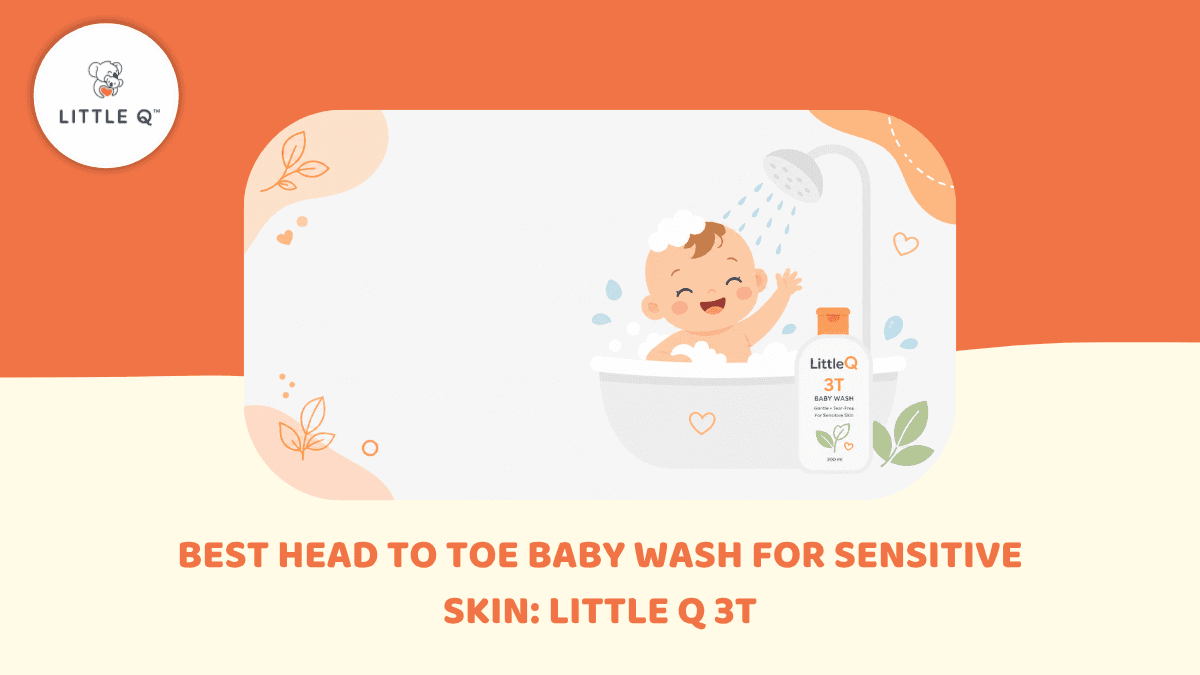
LittleQ 3T is a head-to-toe baby syndet wash for delicate newborn and sensitive skin. The brand describes it as soap-free, pH-balanced and free from harsh sulfates such as SLS and SLES. Its cleansing system includes SCI-85, Decyl Glucoside and Sodium Cocoyl Glycinate, while its conditioning blend includes Ceramide NP, D-Panthenol, Hyaluronic Acid, Niacinamide, Oat, Calendula, Aloe Vera and Licorice.
This guide explains the difference between sulfate-free and syndet cleansing, why the full formula matters and how LittleQ 3T fits into a gentle, barrier-conscious bath routine.
Important note: No cleanser type is ideal for every baby. If your child has eczema, a persistent rash, known allergy or unusual skin reaction, seek personalised advice from a paediatrician or dermatologist.
What Does Sulfate-Free Mean?
“Sulfate-free” means a cleanser does not contain particular sulfate surfactants. The two most commonly discussed are:
Sodium Lauryl Sulfate, or SLS.
Sodium Laureth Sulfate, or SLES.
Surfactants are ingredients that help water mix with sweat, oil and dirt. This allows a cleanser to lift unwanted residue and rinse it away.
SLS and SLES are effective cleansing agents and can create abundant foam. They are commonly used in shampoos, body washes, toothpaste and household cleaning products.
However, some people find certain sulfate surfactants drying or irritating, particularly when products are used often, when the skin barrier is already weak or when the formula includes a high level of cleanser.
What Sulfate-Free Does Not Mean
A sulfate-free baby wash is not automatically:
Soap-free.
Fragrance-free.
Hypoallergenic.
Suitable for eczema.
Free from all synthetic ingredients.
Free from preservatives.
Gentle enough for every baby.
pH-balanced.
A product can avoid SLS and SLES but still contain fragrance, essential oils, dyes, other surfactants or preservatives that may not suit a particular child.
Sulfate-free is one useful piece of label information—but it is not the full story.
What Is a Syndet Wash?
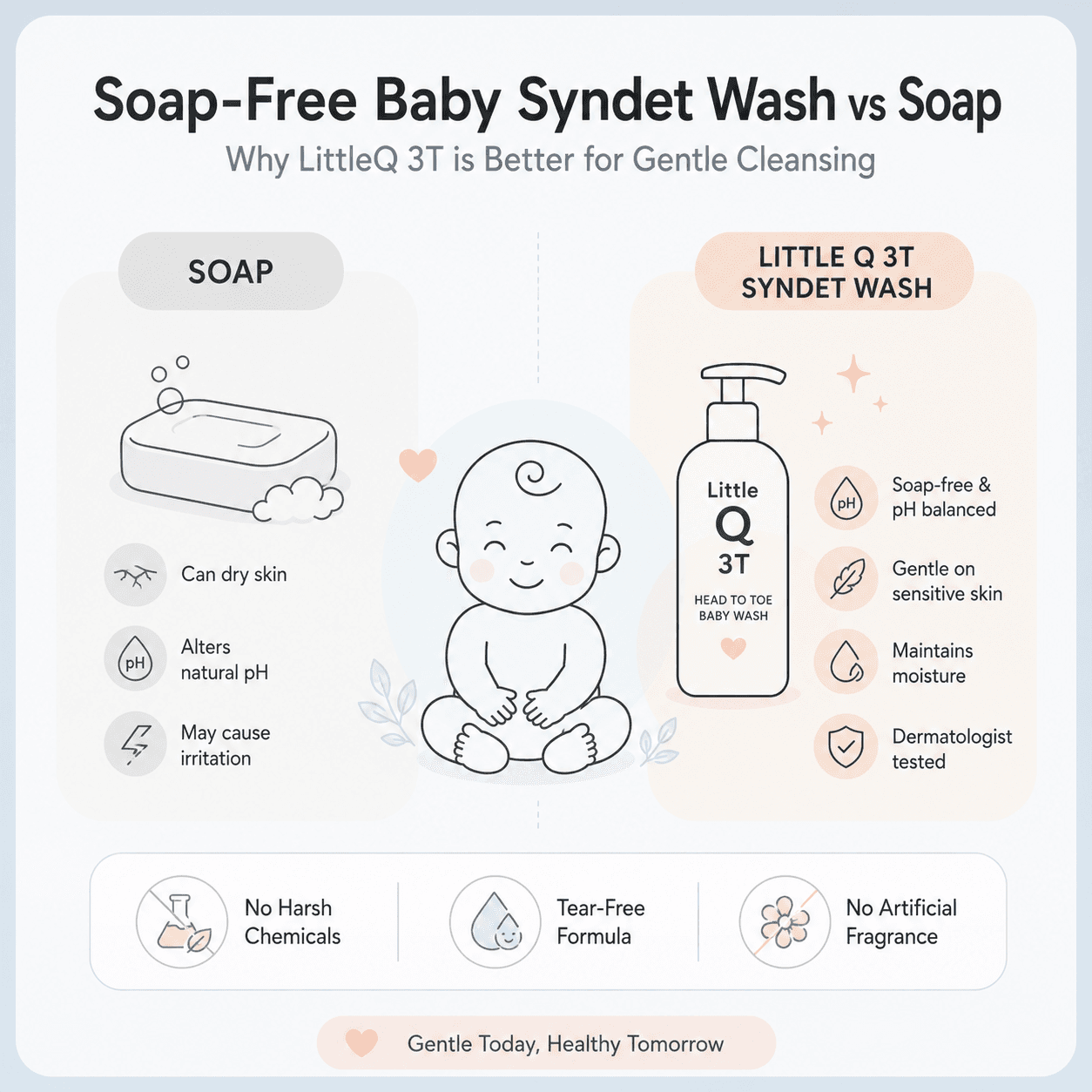
“Syndet” is short for synthetic detergent. A syndet cleanser uses carefully selected synthetic surfactants instead of traditional soap.
Traditional soap is normally produced through a reaction between oils or fats and an alkali. This process often creates a cleansing product with an alkaline pH.
A baby syndet wash uses surfactants that can be formulated closer to the natural, mildly acidic environment of healthy skin.
The Indian Academy of Pediatrics states that it is ideal to use syndet rather than soap for baby cleansing because traditional soap tends to damage the epidermal barrier. It further recommends liquid syndet cleansers with neutral or acidic pH because they are less likely to affect the acid mantle or barrier function.
What Syndet Does Not Mean
Syndet does not mean:
Natural.
Chemical-free.
Fragrance-free.
Allergy-proof.
Automatically suitable for eczema.
Equivalent to a medicated product.
Guaranteed safe for every baby.
“Synthetic” refers to the category of cleansing agent. It does not automatically signal harshness. The full formulation determines whether the cleanser is gentle, irritating, drying or suitable for infant use.
Sulfate-Free vs Syndet: Key Differences
The central difference is straightforward:
1. Sulfate-Free : Sulfate-free describes what the formula excludes.
Syndet : Syndet describes the cleansing system the formula uses instead of traditional soap.
2. Sulfate-Free : A syndet wash may be sulfate-free. But not every sulfate-free product is a syndet.
Syndet : FeatureSulfate-Free CleanserSyndet Cleanser
3. Main claim
Sulfate-Free : Excludes specific sulfate surfactants, usually SLS/SLES
Syndet : Uses synthetic detergent surfactants instead of traditional soap
4. Can contain traditional soap?
Sulfate-Free : Possibly, depending on the product
Syndet : No, it is a non-soap cleansing system
5. pH
Sulfate-Free : Can be acidic, neutral or alkaline
Syndet : Often formulated neutral to mildly acidic
6. Foam level
Sulfate-Free : Can be low, medium or high
Syndet : Can be low, medium or high
7. Mildness
Sulfate-Free : Depends on the complete formula
Syndet : Depends on surfactants, pH and full formula
8. Fragrance-free by default?
Sulfate-Free : No
Syndet : No
9. Suitable for babies by default?
Sulfate-Free : No
Syndet : No
10. Main baby-care advantage
Sulfate-Free : May avoid certain potentially drying sulfates
Syndet : May offer soap-free, pH-conscious cleansing
The most useful conclusion is that both claims can be valuable, but parents should not treat them as interchangeable.
Why Soap-Free Matters for Baby Skin
A baby’s skin is thinner and more sensitive than adult skin. The outer protective system, known as the baby skin barrier, helps retain moisture and reduce exposure to external irritants.
This barrier can be affected by:
1.Hot water.
2.Long baths.
3.Traditional alkaline soap.
4.Strong surfactants.
5.Excessive washing.
6.Friction.
7.Dry weather.
8.Sweat and saliva.
9.Urine and stool.
10.Fragrance and other irritants.
Traditional soap may temporarily raise the skin’s surface pH. It can also remove natural oils that help keep the skin flexible and comfortable.
A review of infant skincare practices concluded that bathing or washing with syndets or mild liquid baby cleansers appears comparable with, or sometimes superior to, water alone for healthy infant skincare.
This does not mean water alone is inadequate. In the earliest newborn period, plain water may be enough for many cleaning needs. The right approach depends on the baby’s age, visible soiling and healthcare guidance.
How LittleQ 3T Cleanses
LittleQ 3T is marketed as a soap-free, pH-balanced, sulfate-free head-to-toe cleanser for babies.littleq
SCI-85
SCI-85 is a form of Sodium Cocoyl Isethionate. It is a mild surfactant used in syndet bars and liquid cleansers.
Its role is to help lift sweat, oil and dirt while creating a soft lather. It does not work through the traditional alkaline soap process.
A soft lather can help distribute the wash without requiring vigorous rubbing.
Decyl Glucoside
Decyl Glucoside is a non-ionic surfactant used in many gentle cleansing formulas.
It helps remove everyday impurities from skin and hair. It is commonly selected for sensitive-skin products, but individual sensitivity remains possible.
Sodium Cocoyl Glycinate
Sodium Cocoyl Glycinate is an amino-acid-based surfactant. It supports cleansing and contributes to the formula’s feel, foam and rinse performance.
Together, SCI-85, Decyl Glucoside and Sodium Cocoyl Glycinate create a multi-surfactant system.
Why a Multi-Surfactant System Matters
A well-formulated cleanser often combines surfactants rather than relying on one strong cleaning ingredient.
This can help balance:
1.Effective cleansing.
2.Mildness.
3.Lather.
4.Easy rinsing.
5.Formula stability.
6.Skin feel.
7.Head-to-toe performance.
The goal is not maximum foam. It is effective cleansing without unnecessary stripping.
Mild Baby Surfactants and Skin Comfort
A mild baby surfactants strategy means choosing cleansing agents that can remove sweat, food residue and oil without needing harsh rubbing or highly alkaline soap.
The surfactant system should work with the skin rather than fight against it.
The Role of pH
Healthy skin has a mildly acidic surface environment. A pH-balanced baby wash is formulated to be closer to this environment than strongly alkaline soap.
The Indian Academy of Pediatrics notes that liquid cleansers with acidic or neutral pH and an appropriate blend of ionic, non-ionic and amphoteric surfactants can avoid affecting the skin barrier and acid mantle.
pH balance alone does not guarantee that a product will be tolerated. Fragrance, preservatives, botanical ingredients, bathing frequency and the baby’s own skin condition are also important.
Ceramide NP
LittleQ 3T includes Ceramide NP, a skin-conditioning lipid associated with the outer skin barrier.
Ceramides help support the lipid structure between skin cells. This structure helps reduce moisture loss.
Because LittleQ 3T is a rinse-off cleanser, Ceramide NP should not be presented as a substitute for a leave-on ceramide moisturiser.
D-Panthenol, Glycerin and Hyaluronic Acid
These ingredients support the formula’s conditioning profile:
D-Panthenol supports a soft, comfortable skin feel.
Glycerin is a humectant that attracts and holds water.
Hyaluronic Acid supports hydration.
Niacinamide supports skin conditioning.
Together, they complement the syndet cleansing base.
Why LittleQ 3T Is a Gentle-Clean Option
The phrase LittleQ 3T gentle clean describes its overall formula approach rather than one isolated ingredient.
The product combines:
1.Sulfate-free positioning.
2.Soap-free syndet cleansing.
3.pH-balanced positioning.
4.Mild surfactants.
5.Ceramide NP.
6.D-Panthenol.
7.Hydration-support ingredients.
8.Head-to-toe convenience.
9.Tear-free positioning.
This makes it a practical option for parents looking for a simplified newborn skincare routine.
However, “superior gentle clean” should not imply that all other sulfate-free products are harsh or that every baby will react the same way. The most appropriate cleanser depends on the baby’s skin, age, climate and individual tolerance.
How to Choose a Baby Wash for Sensitive Skin
Look Beyond Sulfate-Free
A sulfate-free baby wash can be a good starting point, but also check whether the cleanser is soap-free, pH-balanced and intended for babies.
Check the Full Ingredient List
Look for:
1.Mild surfactants.
2.Fragrance information.
3.Preservatives.
4.Botanical extracts.
5.Dyes.
6.Ceramides.
7.Humectants.
8.Age suitability.
Consider Fragrance
Fragrance can irritate some babies. If your baby has eczema-prone or reactive skin, ask a healthcare professional whether fragrance-free products are more suitable.
Use Less Product
A small amount of cleanser is often enough. Excess product may take longer to rinse and may increase the chance of product remaining in skin folds.
Keep Baths Brief
Newborns do not need long baths. Warm water, short bathing and gentle drying support skin comfort.
Observe the Baby’s Skin
Stop using a product and seek advice if the baby develops:
Redness.
Itching.
Swelling.
Hives.
Blisters.
Cracking.
Persistent dryness.
Worsening eczema.
Ongoing discomfort.
Common Label Misunderstandings
“Sulfate-Free Means Soap-Free”
Not necessarily. Sulfate-free and soap-free describe different aspects of a product.
“Syndet Means Chemical-Free”
No. Syndet means synthetic detergent. It refers to a non-soap cleansing system.
“Natural Soap Is Always Gentle”
Natural soap can still be alkaline. Alkalinity may contribute to dryness for some babies.
“More Foam Means Better Cleaning”
Foam is mainly a sensory property. A mild cleanser can clean effectively with low or moderate lather.
“pH-Balanced Means Allergy-Proof”
No. pH balance does not prevent reactions to fragrance, preservatives or botanicals.
“Ceramide Wash Replaces Moisturiser”
No. A wash is rinsed away. A leave-on moisturiser may be needed for dry skin.
Practical Bathing Tips
Use comfortably warm water, not hot water.
Keep baths short.
Use a small amount of cleanser.
Avoid rough sponges and scrubbers.
Clean skin folds gently.
Rinse all cleanser thoroughly.
Pat the baby dry.
Apply a suitable moisturiser if dryness is present.
Introduce only one new product at a time.
Consult a healthcare professional for persistent skin concerns.
YOU ASKED. SCIENCE ANSWERS.
What is the main difference between sulfate-free and syndet?
Sulfate-free vs syndet describes two different things. Sulfate-free means specific sulfate surfactants are absent. Syndet means the product uses synthetic detergent surfactants instead of traditional soap.
Is LittleQ 3T sulfate-free?
LittleQ 3T is described by the brand as free from harsh sulfates such as SLS and SLES. Check the latest product label before purchasing.
Is LittleQ 3T a syndet wash?
Yes. It is marketed as a baby syndet wash and lists SCI-85, Decyl Glucoside and Sodium Cocoyl Glycinate as cleansing agents.
Is a syndet wash better for sensitive baby skin?
A mild syndet may be more compatible with delicate skin than traditional alkaline soap. However, the complete formula and individual tolerance are what matter most.
Can a sulfate-free wash still cause irritation?
Yes. A sulfate-free product may still contain fragrance, essential oils, preservatives or botanicals that do not suit an individual baby.
Does pH-balanced mean it treats eczema?
No. A pH-balanced cleanser may support gentle cleansing but cannot treat eczema, infection or severe rash.
Is LittleQ 3T suitable for newborns?
LittleQ 3T is marketed for 0+ months and all skin types. Follow the current label and ask a healthcare professional for advice if your baby was premature or has a diagnosed skin condition.
What should I do if my baby reacts to a cleanser?
Stop using the product, rinse the skin with clean water and consult a paediatrician or dermatologist if the reaction persists, spreads or becomes painful.
Final Thoughts : Choose Thoughtful Gentle Cleansing
The comparison of sulfate-free vs syndet is not a competition between identical claims. Sulfate-free means a product excludes certain sulfate surfactants. Syndet means it uses a non-soap cleansing system.
LittleQ 3T combines sulfate-free positioning with a pH-balanced, soap-free syndet base and mild surfactants such as SCI-85, Decyl Glucoside and Sodium Cocoyl Glycinate. Its Ceramide NP, D-Panthenol, Hyaluronic Acid and Niacinamide further support its gentle, barrier-conscious formulation.littleq
For parents seeking a gentle baby cleanser, the best approach is to read the full label, use the product sparingly and observe the baby’s skin response.
Choose LittleQ 3T gentle clean for a soap-free, sulfate-free syndet routine designed to support clean, comfortable and healthy-looking baby skin.