
Quick-Rinse Baby Wash: LittleQ 3T No-Residue Clean for Newborns
Discover how Little Q 3T quick-rinse baby wash supports gentle, no-residue cleansing for newborns, sensitive skin and comfortable daily bathing.Little Q

Quick-Rinse Baby Wash: Little Q 3T No-Residue Clean for Newborns
Bath time should leave a baby feeling clean, comfortable and ready for cuddles—not coated with a heavy cleanser or surrounded by unnecessary products. This is why many parents look for a quick-rinse baby wash that cleans gently and washes away easily.
Little Q 3T is a head-to-toe syndet cleanser designed for delicate newborn and sensitive skin. Its listed cleansing agents include SCI-85, Decyl Glucoside and Sodium Cocoyl Glycinate. The formula also includes Ceramide NP, Niacinamide, D-Panthenol, Hyaluronic Acid, Oat, Calendula, Aloe Vera and Licorice. The product is described as pH-balanced, paraben-free and sulfate-free.
A quick-rinse formula can make bath time more convenient, but “no residue” should be understood realistically. Any cleanser should be applied sparingly, rinsed thoroughly and used according to the label. This article explains what makes a cleanser easy to rinse, why residue matters and how Little Q 3T fits into a simple newborn bath routine.
Important note: A baby wash is not a treatment for eczema, infection or severe rash. Consult a paediatrician or dermatologist if your baby has persistent, painful, oozing or worsening skin symptoms.
What Is a Quick-Rinse Baby Wash?
A quick-rinse baby wash is formulated to cleanse the skin and hair while washing away easily with water. The idea is to reduce lingering product film after bathing.
A cleanser’s rinse behaviour depends on several factors:
The type of surfactants used.
The amount of product applied.
The presence of oils, conditioners and polymers.
Water temperature and hardness.
How thoroughly the baby is rinsed.
Whether the cleanser is used on skin, hair or both.
A quick-rinse product should not be confused with a product that requires no rinsing. Baby cleansers should normally be removed from the skin after cleansing unless the label specifically states otherwise.
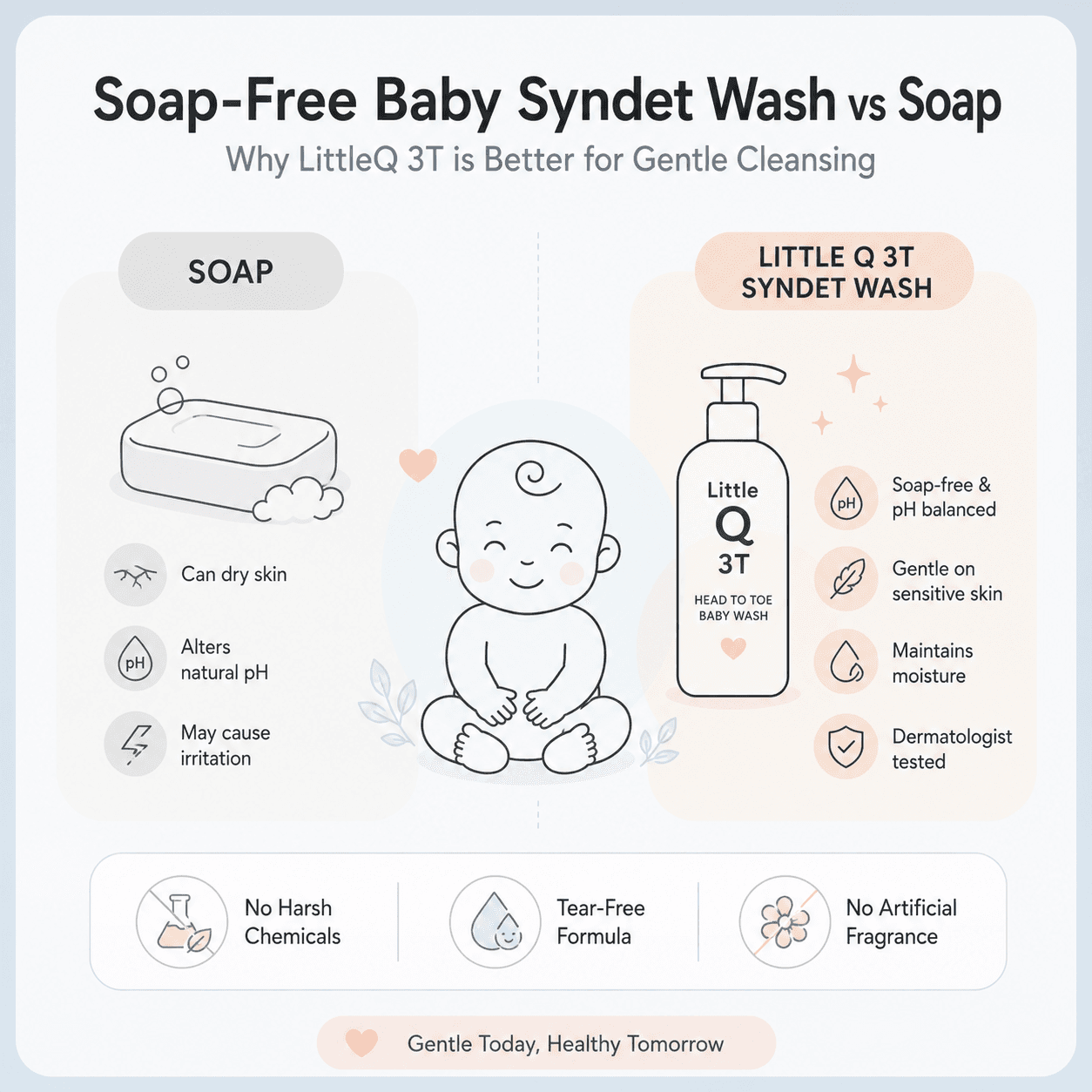
Little Q 3T is positioned as a head-to-toe cleanser using mild surfactants and a quick-rinse format. The product information highlights SCI-85, Decyl Glucoside and Sodium Cocoyl Glycinate as part of the cleansing system.
Why Cleanser Residue Matters
A small amount of leftover cleanser may not cause a problem for every baby, but residue can become uncomfortable when it collects in skin folds.
Areas such as the neck, underarms, behind the ears, groin and behind the knees may retain moisture and product more easily. If the skin is already sensitive, leftover product may contribute to discomfort or irritation.
Possible signs that a cleanser is not rinsing well include:
A slippery or sticky film after bathing.
Skin that feels coated rather than clean.
Increased redness in skin folds.
Dryness or itching after repeated use.
Product collecting around the neck or underarms.
Hair that feels heavy or difficult to rinse.
These signs do not prove that residue is the cause. Irritation may also result from fragrance, heat, friction, eczema, sweat or another product.
Why No-Residue Cleansing Is Useful
A no-residue baby wash can support a cleaner after-bath feel. When a cleanser rinses away easily, parents may spend less time repeatedly rubbing or rinsing the baby’s skin.
This matters because excessive rubbing can also cause irritation. A cleanser that rinses efficiently can help parents use gentle movements rather than prolonged scrubbing.
How a Syndet Cleanser Rinses Away
Syndet cleansers use surfactants rather than traditional soap. Surfactants help water interact with oil and dirt, allowing impurities to be lifted and rinsed away.
A mild baby syndet wash may provide effective cleansing without leaving the alkaline soap film sometimes associated with conventional soap products.
The Indian Academy of Paediatrics recommends mild syndet-type cleansers for babies and notes that liquid cleansers with neutral or acidic pH are preferred because they are less likely to disturb the skin barrier and acid mantle.
The surfactant system is important, but it is not the only factor affecting rinseability. A formula also needs to balance cleansing, foam, moisturising ingredients and skin comfort.
Little Q 3T Formula Highlights
SCI-85
SCI-85 is a form of Sodium Cocoyl Isethionate. It is a mild surfactant used in syndet cleansers.
Its role is to help lift sweat, dirt and excess oil from the skin while creating a soft lather. It is not traditional soap and does not depend on a strongly alkaline soap base.
A mild cleanser should remove everyday impurities without making the skin feel excessively tight.
Decyl Glucoside
Decyl Glucoside is a non-ionic surfactant used in gentle cleansing products. It helps remove impurities from the skin and hair.
Parents seeking a gentle baby cleanser may find this ingredient in formulas designed for delicate skin. However, no ingredient is guaranteed to suit every baby.
Sodium Cocoyl Glycinate
Sodium Cocoyl Glycinate is an amino-acid-based surfactant. It supports cleansing and contributes to the formula’s rinse and skin-feel properties.
Little Q 3T combines it with other mild surfactants. This combination helps the product clean without relying on one aggressive cleansing agent.
Ceramide NP
Ceramide NP is a skin-conditioning lipid associated with the outer skin barrier. Ceramides help support the structure that limits moisture loss.
Little Q 3T includes Ceramide NP in its formula. This may appeal to parents who want cleansing that is mindful of the baby skin barrier.
Because the product is rinsed off, Ceramide NP should not be treated as a replacement for a leave-on moisturiser.
D-Panthenol, Hyaluronic Acid and Glycerine
D-Panthenol, Hyaluronic Acid and Glycerine are commonly used in skincare for conditioning and hydration support.
D-Panthenol may contribute to a soft skin feel. Hyaluronic Acid and Glycerine are humectants that help attract and hold water.
Their effect is more limited in a rinse-off product than in a cream or lotion. However, they contribute to the formula’s moisturising profile.
Oat, Calendula, Aloe Vera and Licorice
These botanical ingredients are included in the product’s skin-comfort blend. Oat is commonly used in products for dry skin, while Aloe Vera, Calendula and Licorice are widely found in conditioning skincare formulas.
Natural ingredients can still cause sensitivity. Parents should be careful if their baby has a known allergy to botanical extracts.
Benefits of a No-Residue Cleansing Approach
1. A Cleaner After-Bath Feel
When a cleanser rinses away easily, the skin may feel clean without a heavy or slippery coating.
This can be especially helpful for babies whose skin folds retain moisture or who become uncomfortable when products remain on the surface.
2. Less Rubbing During Rinsing
A cleanser that washes away efficiently may reduce the need for repeated rubbing. This supports gentler handling of delicate skin.
Parents should still rinse carefully, especially around the neck, underarms, behind the ears and diaper area.
3. More Comfortable Hair Cleansing
When a head-to-toe product is used on the hair, easy rinsing can help prevent a heavy or sticky after-feel.
Little Q 3T is marketed as a head-to-toe cleanser for scalp, hair and body.
4. Useful for Sensitive Skin Routines
A baby wash for sensitive skin should cleanse without unnecessary friction or excessive stripping.
A quick-rinse formula can support this approach by shortening the time spent cleansing and rinsing. However, parents should also check the formula’s fragrance, preservatives and botanical ingredients.
5. Simplifies Travel
A single product that cleanses the hair and body can reduce the number of bottles parents need to pack.
This is useful for travel, visits to grandparents, daycare bags and overnight stays.
Why pH and Rinseability Work Together
A pH-balanced baby wash is designed to be compatible with the skin’s natural surface environment. A quick-rinse design addresses a different concern: how easily the product leaves the skin during bathing.
Both features may contribute to comfort, but they should not be confused.
pH relates to the product’s acidity or alkalinity.
Rinseability relates to how the formula washes away.
Mild surfactants relate to how the cleanser removes dirt.
Conditioning ingredients relate to the afterbath feel.
Fragrance and preservatives relate to potential individual sensitivity.
A well-designed baby cleanser needs to balance all these factors.
Choosing a Baby Cleanser for Newborns
Look for Mild Surfactants
Select a cleanser with mild cleansing agents and avoid if more foam means better performance.
Check the pH
Neutral or mildly acidic cleansers may be more suitable for infant skin than strongly alkaline soap. The Indian Academy of Paediatrics recommends mild cleansers that do not disturb the acid mantle.
Review Fragrance
Fragrance may irritate some babies, particularly those with reactive or eczema-prone skin.
Check the Age Guidance
Some newborn-care guidance recommends plain water during the earliest weeks. Parents should follow healthcare advice, particularly if the baby was premature or has a skin condition.
Read the Full Ingredient List
Look for:
Cleansing agents.
Moisturising ingredients.
Ceramides or other barrier-support ingredients.
Fragrance information.
Preservatives.
Botanical extracts.
Dyes and essential oils.
Assess the Packaging
Reliable packaging should include the manufacturer’s details, batch number, expiry information, directions and warnings.
Practical Bath-Time Considerations
A quick-rinse cleanser works best when used correctly.
Use a small amount rather than creating excessive foam.
Avoid applying cleanser directly into the eyes.
Clean gently without scrubbing.
Rinse all skin folds thoroughly.
Pat the baby dries rather than rubbing.
Keep the bath short.
Never leave the baby unattended near water.
Frequently Asked Questions
What is a quick-rinse baby wash?
It is a cleanser designed to wash away easily with water, helping reduce lingering product film after bathing.
Is Little Q 3T a no-residue baby wash?
Little Q 3T is positioned as a quick-rinse cleanser. Parents should still use a small amount and rinse thoroughly, because residue depends on product quantity, water, skin folds and bathing technique.
Is Little Q 3T suitable for newborns?
The product is marketed for delicate newborn and sensitive skin. Check the current packaging and age guidance. If the baby was premature or has a diagnosed skin condition, consult a healthcare professional.
Can I use Little Q 3T on hair and body?
The product is marketed as a head-to-toe cleanser. Use it on the scalp, hair and body according to the product directions.
Is it suitable for sensitive skin?
Little Q 3T is positioned as a cleanser for delicate and sensitive skin. However, individual responses differ. Stop using it if irritation develops.
Is quick-rinse the same as tear-free?
No. Quick rinse describes how easily the product washes away. Tear-free describes a formula designed to reduce stinging around the eyes. They are separate features.
Does a quick-rinse cleanser moisturise the skin?
Rinseability and moisturising are different properties. Little Q 3T includes conditioning ingredients, but a wash-off product should not replace a leave-on moisturiser when the skin is dry.
What should I do if my baby develops irritation?
Stop using the product and rinse the skin with clean water. Contact a paediatrician if the reaction persists, spreads or becomes painful. Seek urgent help for facial swelling, breathing difficulty or widespread hives.
Final Thoughts: Fresh, Gentle and Easy to Rinse
A quick-rinse baby wash can make bathing more comfortable by cleansing effectively without leaving an unwanted product film. Little Q 3T combines mild syndet surfactants with a head-to-toe format, pH-balanced positioning and conditioning ingredients such as Ceramide NP, D-Panthenol, Hyaluronic Acid and Aloe Vera.
Its quick-rinse approach may be useful for parents who want clean, comfortable-feeling skin and a simpler bath routine. However, the best results come from using a small amount, rinsing carefully and observing the baby’s individual skin response.
Disclaimer: The information in this blog is here to help and inform, but it is not a replacement for advice from a doctor or nutritionist. We try to share correct and useful information, but we always suggest talking to your child’s pediatrician or nutritionist for specific advice about their health and nutrition. These professionals know what’s best for your child’s unique needs.