Baby Bath Products for Indian Water: Little Q 3T Guide
Learn how hard water affects baby skin and why Little Q 3T’s pH-balanced syndet wash may support a gentler bath routine in Indian homes.Little Q
Baby Bath Products for Indian Water: Little Q 3T Hard Water Safe
Many Indian homes receive hard water, especially in areas where tap water contains higher levels of dissolved calcium and magnesium. Parents often notice dry patches, roughness or irritation after bathing and wonder whether their baby bath products for Indian water are making things worse.
Hard water does not mean water is unsafe to bathe in. However, it can contribute to dryness for some babies, particularly when baths are long, hot or use harsh soap.
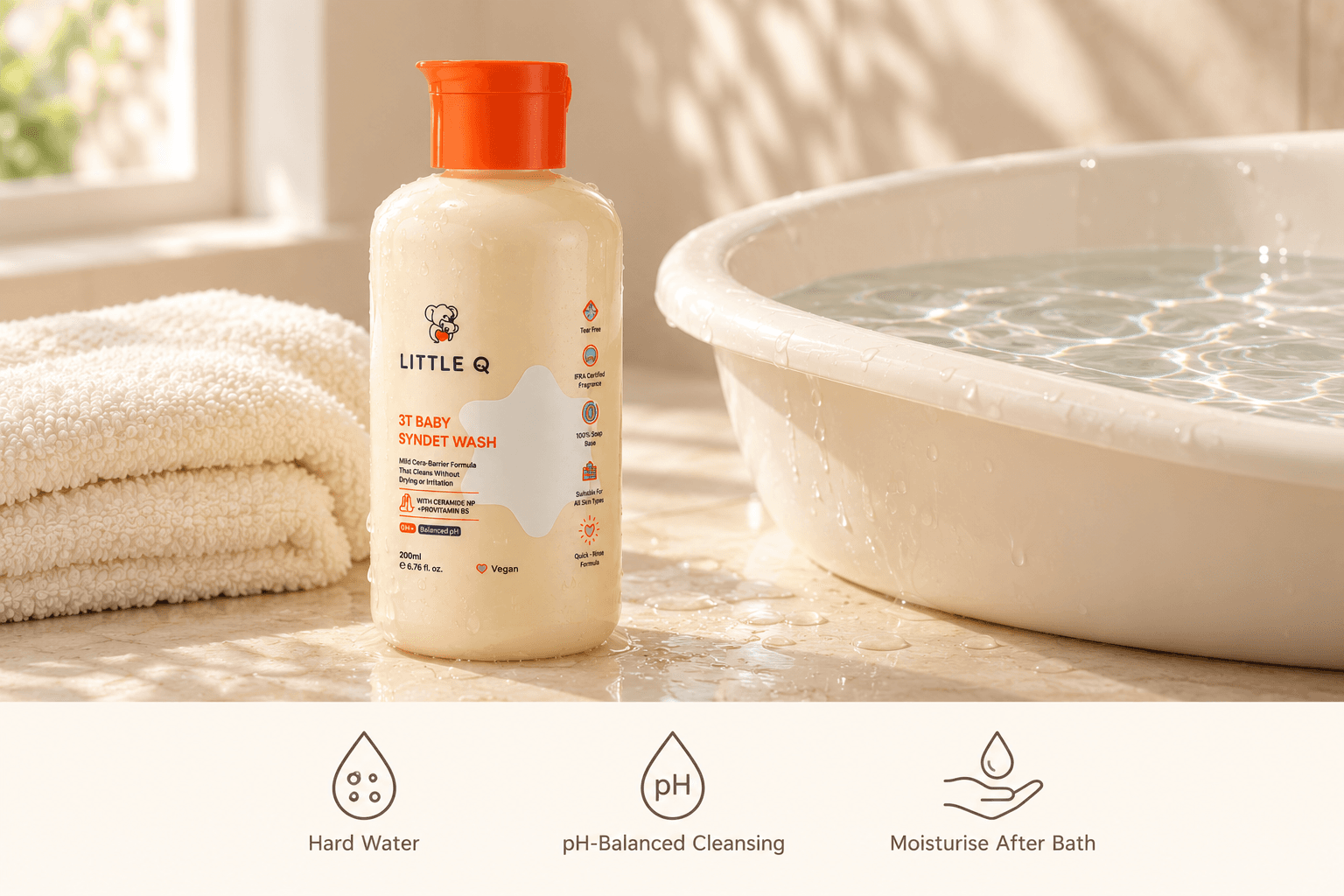
Little Q 3T baby wash is a head-to-toe syndet cleanser designed for delicate newborn and sensitive skin. Its manufacturer describes it as soap-free, pH-balanced, paraben-free and sulfate-free, with mild cleansing agents including SCI-85, Decyl Glucoside and Sodium Cocoyl Glycinate.
This guide explains how hard water may affect baby skin, what “hard-water-safe” should realistically mean and how to build a bath routine that protects your baby’s skin barrier.
What Hard Water Means in Indian Homes
Hard water contains dissolved minerals, mainly calcium and magnesium ions. The U.S. Geological Survey defines hard water as water containing these divalent cations at concentrations above 120 ppm.
Water hardness varies widely by geography, source and treatment method. In India, households may experience different water hardness depending on whether they use municipal supply, borewell water, tanker water or filtered water.
Hard water is not automatically harmful. Many babies bathe in it without problems. But its minerals can interact with cleansers and may leave a feeling of residue on skin or hair.
The key issue is not fear of water. It is choosing a routine that cleans gently and supports the skin barrier.
How Hard Water Can Affect Baby Skin
Baby skin is still developing. The HSE advises that infant skin can be more vulnerable to irritation from chemicals and fragrances found in some bath products.
Hard water may contribute to dryness in several ways:
Calcium and magnesium can bind to the skin surface.
They may interact with some cleansing ingredients.
Water alone can remove natural moisturising factors from the outer skin layer.
Long baths and hot water can increase moisture loss.
Harsh soap can disrupt the skin’s surface balance.
Research published in Clinical, Cosmetic and Investigational Dermatology notes that hard water has been associated with atopic dermatitis in several observational studies. It also explains that certain baby cleansers can bind free calcium ions and reduce the effective hardness of bath water in laboratory conditions.
That finding is about specially formulated cleansers tested under defined conditions. It does not mean every baby wash softens household water or prevents eczema.
What “Hard-Water-Safe” Should Mean
“Hard-water-safe” is not a regulated medical claim. Parents should interpret it carefully.
A more useful way to think about it is this: a hard-water-safe baby wash should be formulated to cleanse gently in mineral-rich water without relying on harsh soap or excessive stripping.
That generally means:
A mild, non-soap cleansing base.
A pH profile that respects baby skin.
Easy rinsing.
Conditioning ingredients that support comfort.
Minimal unnecessary irritants.
A routine that includes prompt moisturising when needed.
Little Q 3T is described by its manufacturer as pH-balanced, soap-free and sulfate-free. These characteristics align with the general principles of gentle baby cleansing, but they do not prove a specific effect on every home’s water supply.
Why Syndet Cleansers Matter
A baby syndet wash uses synthetic detergent surfactants instead of traditional soap. This matters because traditional soap can be alkaline and may contribute to dryness.
Evidence-based Indian neonatal skin-care recommendations state that liquid cleansers with a mildly acidic or neutral pH, generally in the range of 5.5 to 7, are preferred over alkaline agents because alkaline products can disrupt skin surface pH and lipids.
The same consensus guidance notes that hard water contains ionised calcium and magnesium and may irritate skin. It also explains that certain anionic surfactants in syndet cleansers can interact with these minerals, potentially changing the water’s composition and reducing the ions available to bind to skin.
Again, this is a formulation-level principle. It does not mean that every syndet wash will perform identically in every Indian household.
How Little Q 3T Fits a Hard-Water Routine
Little Q 3T is positioned as a head-to-toe baby syndet wash. Its manufacturer identifies mild cleansers including SCI-85, Decyl Glucoside and Sodium Cocoyl Glycinate.
SCI-85: a syndet cleansing ingredient
SCI-85 is a commercial grade of Sodium Cocoyl Isethionate. It is used in syndet products to support cleansing and lather.
Its role is to help lift sweat, oil and everyday residue so they can be rinsed away.
Decyl Glucoside and Sodium Cocoyl Glycinate
Decyl Glucoside is a non-ionic surfactant. Sodium Cocoyl Glycinate is an amino-acid-based surfactant.
Together, these cleansing agents contribute to the formula’s cleansing and skin-feel profile. A blend can help balance cleansing, foam and rinse behaviour.
Conditioning support
Little Q 3T also includes Ceramide NP, Niacinamide, D-Panthenol, Hyaluronic Acid, Glycerin, Oat, Calendula, Aloe Vera and Licorice.
These ingredients support the product’s conditioning positioning. Ceramide NP is particularly relevant because ceramides are lipids that help form part of the skin barrier.
However, a rinse-off wash cannot replace a leave-on moisturiser. If your baby’s skin feels dry after bathing, a suitable moisturiser may still be needed.
A Simple Hard-Water Bath Routine
A good routine for hard water baby skin is short, gentle and consistent.
Before the bath
Warm the bathroom.
Keep towels, nappy and clothes ready.
Use lukewarm water, not hot water.
Keep Little Q 3T within reach.
During the bath
Keep baths brief.
Use only a small amount of cleanser.
Clean visible soil, skin folds and the nappy area gently.
Avoid scrubbing with rough cloths or loofahs.
Rinse thoroughly, especially around the neck, armpits and groin.
After the bath
Pat the skin dry rather than rubbing.
Apply a suitable moisturiser if the skin feels dry.
Dress your baby promptly.
Avoid layering multiple new products at once.
Indian neonatal skin-care guidance notes that soaking in water, with or without cleansers, can remove natural moisturising factor from the outer skin layer and lead to dry, brittle skin. It recommends water alone or a mild liquid cleanser for bathing, depending on the baby’s needs.
Signs Your Baby Needs Extra Skin Support
Some dryness is common in newborns, especially in the first few weeks. But watch for signs that the routine may need adjustment:
Tight or rough skin after bathing.
Flaking on the arms, legs or cheeks.
Redness in skin folds.
Itching or frequent scratching.
Cracked or irritated areas.
Worsening eczema.
A rash that does not improve.
If dryness appears after bath time, try shorter baths, cooler water and a suitable moisturiser. The HSE advises that an emollient can be used on dry patches from around four weeks of age, and recommends choosing products without colours, perfumes or alcohol.
When to Seek Medical Advice
Speak with a paediatrician or dermatologist if your baby has:
Persistent dryness despite a gentle routine.
Red, itchy or inflamed skin.
Cracked, bleeding or oozing skin.
A rash that spreads.
Signs of infection.
Known eczema that is worsening.
A reaction after using a new product.
Do not stop prescribed eczema treatment or replace it with a cosmetic wash without medical advice.
Frequently Asked Questions
1. Is hard water bad for babies?
Not necessarily. Many babies bathe in hard water without problems. However, it may contribute to dryness or irritation in some babies, especially when baths are long or products are harsh.
2. What are the best baby bath products for Indian water?
Look for a mild, soap-free or syndet cleanser with a baby-appropriate pH, easy rinsing and conditioning support. Avoid assuming that “hard-water-safe” means a product will soften your household water.
3. Does Little Q 3T soften hard water?
Little Q 3T is a syndet cleanser, and research shows that some specially formulated baby cleansers can reduce free calcium ions in defined laboratory conditions. This does not prove that Little Q 3T softens every home’s tap water or prevents eczema.
4. Can hard water cause eczema?
Hard water has been associated with atopic dermatitis in observational studies, but association is not proof of cause. Babies with a family history or existing eczema may need individualised advice.
5. Should I use soap for my baby in hard water?
Traditional soap can be drying. Indian neonatal skin-care guidance prefers mildly acidic or neutral liquid cleansers over alkaline agents.
6. How often should I bathe my baby in hard water?
There is no single rule. Keep baths short and use a mild cleanser only when needed. The HSE advises plain water for the first four weeks or so, then a suitable emollient for dry patches if needed.
7. What should I do if my baby’s skin feels dry after bathing?
Shorten the bath, use lukewarm water, rinse well and apply a suitable moisturiser. If dryness persists or worsens, consult a paediatrician or dermatologist.
Finalthoughts:
Choosing baby bath products for Indian water is less about finding a product that promises to “fix” hard water and more about choosing a gentle routine that protects your baby’s skin barrier.
Little Q 3T hard water safe positioning is best understood through its syndet cleansing approach: soap-free, pH-balanced and formulated with mild cleansers and conditioning ingredients. Combined with short, lukewarm baths and prompt moisturising, it can fit into a practical routine for Indian households.
Choose Gentle Cleansing for Indian Water
Explore Little Q 3T baby wash, read the current label and build a short, gentle bath routine suited to your home’s water. For eczema, persistent dryness or skin reactions, consult your child’s paediatrician or dermatologist.
Disclaimer
The information in this blog is here to help and inform, but it is not a replacement for advice from a doctor or nutritionist. We try to share correct and useful information, but we always suggest talking to your child’s paediatrician or nutritionist for specific advice about their health and nutrition. These professionals know what’s best for your child’s unique needs.